Architecture
The full architecture deep-dive lives in the repository at ARCHITECTURE.md.
This page is a short orientation.
Client/server topology
Choreographr separates the daemon that runs sessions from the clients that connect and disconnect at any time.
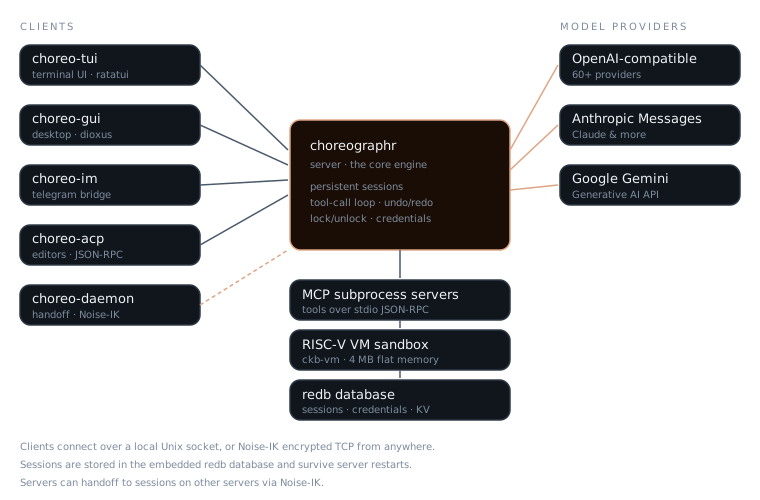
- The client can run on the same computer as the daemon (via a local Unix socket), or the daemon can live anywhere on your local network or the Internet.
- When connecting remotely, clients use Noise-IK encrypted TCP.
- Because the daemon can live anywhere and is reachable over encrypted TCP, it
can also be reached from mobile devices — for example, chatting with your
agent on the go via the
choreo-imTelegram bridge. - Daemons can also connect to each other —
choreo-daemonacts as a client of other daemons, handing off sessions over Noise-IK encrypted TCP to deploy work elsewhere.
Client/server communication is encoded via Postcard.
Threading model
The daemon uses pure OS threads with message passing (actor model) — no
async code in its own logic, and no Arc<Mutex> shared state. All I/O uses
blocking std APIs on dedicated threads:
main()
├── listener thread — UnixListener accept loop
│   └── per client: spawns client_thread
├── metrics HTTP thread — (optional) serves /metrics
├── command thread — DaemonCommand receiver loop
│   └── owns DaemonState (exclusive access)
├── per-session threads — one per active session
│   └── owns SessionState (exclusive access)
└── main thread — polls shutdown flag, orchestrates exit
This keeps the mental model simple — each thread owns its data — and avoids the
complexity of async cancellation. The one exception is the optional
blockchain feature: the choreo-blockchain crate (linked only then) holds a
tokio sidecar runtime for the async alloy/subxt clients, and the daemon calls
its synchronous execute_* entry points (which block_on internally).
Request flow
RunInput received
  └► validate session, check active requests
     └► tool-call loop (daemon-wide cap, default 0 = unlimited):
        1. build system content (skills + context, fingerprint-cached)
        2. send messages + tools → model
        3. receive response
        4. if tool_call → execute tool → repeat
        5. else → emit final text, Done
Concurrent tools are dispatched across multiple OS threads in parallel;
session-config tools (load_tools, unload_tools, set_working_dir) run
serially to preserve ordering.
Workspace topology
Fourteen crates in a single Cargo workspace (resolver = "3"). The dependency
spine is choreo-proto → choreo-keystore / choreo-transport, with
choreo-client-core and the daemon on top, and clients (choreo-tui,
choreo-gui, choreo-im, choreo-acp) as leaves. The daemon itself also
acts as a client — choreo-daemon can connect to other daemons to handoff
sessions.
| Crate | Description |
|---|---|
choreo-daemon | The core engine — binary choreographr. Unix socket server that validates credentials, manages persistent sessions (with sub-sessions and working directories), runs requests with a tool-call loop, and streams responses. Also connects to other daemons over Noise-IK to handoff sessions and deploy work elsewhere |
choreo-ai-protocols | Provider protocols — OpenAI-compatible, Anthropic Messages, and Google Gemini clients, the ProviderClient trait, and the provider catalog (70+ providers) |
choreo-blockchain | Blockchain tools — EVM (alloy) and Substrate/Polkadot (subxt) read-only queries plus the tokio sidecar runtime they run on; pulled in by the daemon's blockchain feature (off by default) |
choreo-proto | Framed binary protocol (postcard + length prefix) shared between clients and daemon |
choreo-keystore | X25519 keypair + ECDH/AES-256-GCM crypto library for encrypted credentials |
choreo-transport | Noise-IK encrypted transport over TCP |
choreo-mcp | MCP (Model Context Protocol) client — spawns subprocess servers, discovers tools, dispatches calls over JSON-RPC stdio |
choreo-acp | ACP (Agent Communication Protocol) bridge — translates JSON-RPC 2.0 over stdin/stdout into choreo-proto messages so ACP-compatible editors can drive sessions |
choreo-tui | Full-screen terminal UI client (ratatui + crossterm) |
choreo-gui | Desktop GUI client (Dioxus) |
choreo-im | Instant messaging bridge (Telegram) |
choreo-client-core | Shared parsing, markdown, image assembly, and daemon-message dispatch for UI clients |
choreo-markdown | Markdown parser and HTML renderer (pulldown-cmark + ammonia) |
Wire protocol
Client/daemon communication is a framed binary protocol (postcard + length
prefix), defined in choreo-proto. Remote connections are wrapped in the
Noise IK encrypted transport from choreo-transport.
Provider architecture
Three layers:
ProviderClienttrait (choreo-ai-protocols) — the wire-protocol layer for OpenAI-compatible, Anthropic Messages, and Google Gemini clients.InferenceProvider(choreo-daemon) — a protocol-erased facade wrapping anArc<dyn ProviderClient>plus the catalog slug; records API metrics.- Provider Catalog (
choreo-ai-protocols/src/catalog/) — one TOML file per provider with a curated model list, context windows, and reasoning levels. Adding a provider is a data-file edit, not code.